
JetBlue Airlines
Psychiatric Service
Dog Policy



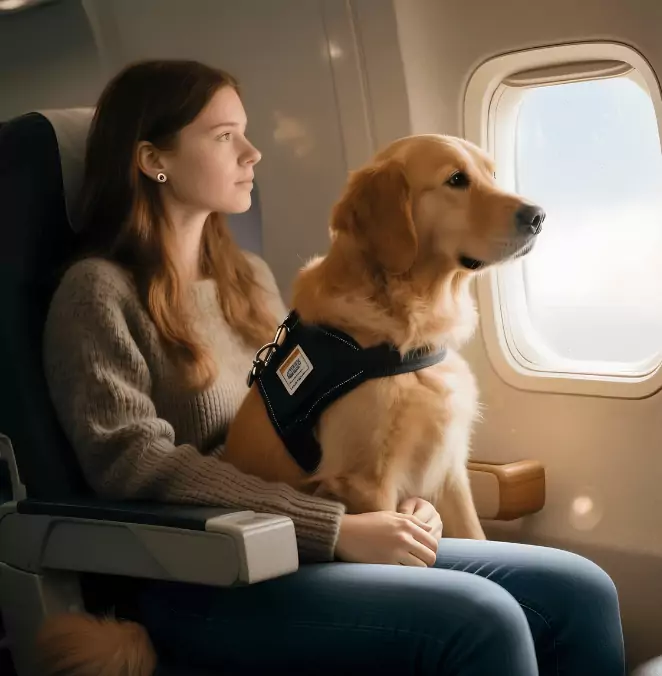
JetBlue Airlines Main Takeaways:
-

Trained service dogs fly free on JetBlue with required DOT form submitted 48 hours in advance.
-
Emotional support animals are no longer recognized as service animals and must travel as pets with extra fee.
-
Service dogs must be task-trained for your disability, not just provide comfort.
-
Only dogs are accepted as service animals; no other species permitted.
-
Service dogs must be at least 6 months old and microchipped for U.S. entry.
-
Animals must remain harnessed and fit within your foot space without encroaching on other passengers.
-
Service animals in training are not accepted on JetBlue flights.
Understanding JetBlue Airlines’ Service Animal Policy
JetBlue Airlines welcomes passengers with disabilities traveling with trained service dogs on all flights. Service dogs travel free of charge in the aircraft cabin and receive full protection under federal disability laws. This guide covers current regulations, required documentation, and what to expect when flying with a psychiatric service dog on JetBlue.
The Air Carrier Access Act: Federal Law Governing Airline Policies
The Air Carrier Access Act (ACAA), enacted in 1986 and codified at 49 U.S.C. § 41705, prohibits discrimination against air travelers with disabilities. Enforced by the U.S. Department of Transportation through 14 CFR Part 382, the ACAA applies to all U.S. airlines and foreign airlines operating flights to or from the United States. The law requires airlines to allow trained service dogs in the cabin at no charge, provide boarding assistance, and make reasonable accommodations for passengers with disabilities. JetBlue complies fully with ACAA requirements and ensures equal treatment for all passengers traveling with service animals.
Important Policy Change: Emotional Support Animals No Longer Recognized on Flights
Following U.S. Department of Transportation rule changes effective January 2021, JetBlue modified its animal travel policies. This fundamental change affected how airlines handle emotional support animals on all flights.
Before 2021: Old ESA Rules
- Service animals and emotional support animals both flew free in the cabin
- ESA letters from mental health professionals were accepted as sufficient documentation
- Various animal species were accommodated at no charge
- Minimal documentation requirements for ESAs
After 2021: Current ESA Rules
- Only trained service dogs are recognized as service animals
- Emotional support animals are no longer recognized as service animals
- ESAs must travel as regular pets with applicable fees and restrictions
- PSDs (task-trained) still qualify for free accommodation
- Stricter documentation requirements including DOT Service Animal Form
Psychiatric Service Dogs vs. Emotional Support Animals
The key distinction is task training. Psychiatric service dogs must perform specific trained tasks such as interrupting panic attacks, reminding you to take medication, providing deep pressure therapy during anxiety episodes, guiding you to safety during psychiatric episodes, waking you from nightmares, or creating physical barriers in crowded spaces. If your dog only provides comfort without performing trained tasks, it’s classified as an ESA and must travel as a pet with applicable fees and restrictions.
Advanced Notice
Notify JetBlue when booking your reservation that you’ll travel with a service dog, then inform staff again at airport check-in. JetBlue requires providing notification at least 48 hours before your scheduled departure to ensure proper seating arrangements and smoother boarding.
Submit your DOT Service Animal Form when booking or as soon as possible before your flight. If you purchase tickets less than 48 hours before departure, you may complete the form at the airport with a Complaints Resolution Official, but arrive early to allow time for processing.
Contact JetBlue by phone at 1-800-JETBLUE (1-800-538-2583). You can also manage reservations and add service dog information online at jetblue.com. If your itinerary includes flights operated by partner airlines, contact those airlines separately to confirm their service dog guidelines.

JetBlue Airlines Service Dog Requirements
DOT Service Animal Form Requirements
The U.S. Department of Transportation Service Animal Air Transportation Form is mandatory for service dogs on JetBlue flights. You must attest to your dog’s task training for your disability, confirm appropriate public behavior, verify your dog won’t threaten other passengers, and for flights over eight hours, attest your dog can refrain from relieving itself or do so sanitarily using absorbent pads.
JetBlue has partnered with Service Animal Forms Portal to streamline service animal travel notification. Submit your form through the portal to ensure your service dog will be added to your reservation prior to travel.
If you prefer, you may mail a hard copy of a completed DOT form to JetBlue Airways, Attn: Customer Accessibility, 6322 S 3000 E G10, Salt Lake City, UT 84121 USA. JetBlue recommends carrying a hard copy or electronic version of your form and portal approval when you travel.
Training Requirements for Service Dogs
JetBlue accepts only trained service dogs that perform work or tasks for the benefit of a qualified individual with a disability. Service animals in training are not accepted for travel on JetBlue. The behavior of all service animals will be assessed at the airport to ensure safety requirements are met.
Health Certificate Requirements
Health certificate and entry requirements vary based on destination.
- Puerto Rico and the U.S. Virgin Islands require vaccination documentation for the animal to be admitted into the destination.
- International destinations have vaccination and documentation requirements that vary by country. Visit the USDA-APHIS Pet Travel tool for destination-specific requirements.
- Dogs entering the U.S. must meet CDC requirements. All dogs (including service animals) regardless of origination country or vaccination status must appear healthy, be at least 6 months old, be microchipped with proof required, and have a completed CDC Import Form receipt.
- Additional documents are required for dogs entering the U.S. from high-risk countries according to the CDC. Port of entry is determined by vaccination status.
Behavior Standards During Flight
JetBlue requires all service animals to be under the control of the handler at all times in the airport and on the plane and must be harnessed, leashed, or otherwise tethered. All animals must remain on the floor, unless the animal is small enough to fit fully on the traveler’s lap without touching any part of the seat, tray table, or nearby travelers.
Service dogs must behave appropriately without excessive barking, biting, jumping, or displaying aggression toward passengers or crew. No animal is ever allowed to occupy a seat. Dogs cannot block aisles or areas that must remain unobstructed for emergency evacuation. JetBlue may refuse transport or remove animals creating safety concerns or significant disruptions.
Seating Rules for Service Dog Handlers
JetBlue permits service animals to accompany you in any seat except the emergency exit row, unless the animal obstructs an aisle or other area that must remain unobstructed in order to facilitate an emergency evacuation.
Service Animals in Mint: Service animals are allowed in Mint seating, but you will forfeit the lie-flat feature in order to accommodate your service animal on the floor. If your service animal is small enough to fit fully on your lap without touching any part of the seat, the lie-flat feature may be used.
Number of Service Dogs: If you are traveling with a large service animal or two service animals, your animal(s) must fit within the footprint of the seat(s) you have purchased. If your animal(s) is too large to fit in the seat(s) foot space you have purchased, you may purchase additional seat(s) to guarantee travel or wait for a flight that has sufficient empty seats available.
No Fees for Service Dogs
Service dogs travel completely free under federal disability laws. JetBlue does not charge for cabin access, documentation processing, or any disability-related accommodations. You only pay for your own passenger ticket.
Emotional Support Animals: Traveling as Pets on JetBlue Flights
JetBlue no longer accepts emotional support animals as service animals. Your emotional support animal must travel as a regular pet with all applicable fees and restrictions.
Pet Fees
The pet fee is $150 (one hundred and fifty US dollars) each way and can be added in the Extras section during booking. A maximum of two pets per traveler is allowed, each in their own carrier. In order to bring a second pet, a second seat and pet fee must be paid.
Pet Carrier Size Requirements
Only small dogs and cats are accepted on JetBlue. Your pet and approved pet carrier count as one personal item and must fit under the seat in front of you.
Pet carriers must be FAA-approved and no larger than 17″ L x 12.5″ W x 8.5″ H (43.18 cm L x 31.75 cm W x 21.59 cm H). Only one pet is allowed per carrier, and they must be able to turn around comfortably when it’s closed. You can purchase a pet carrier at JFK T5 ticket counter pending availability with credit card payments only.
Pet Travel Requirements
- All pets must remain inside the pet carrier while at the airport and on the plane.
- If you purchased an additional seat for your pet, the carrier and pet must be stowed under the seat for taxi, takeoff and landing but can be placed on the empty seat during the flight.
- Dogs and cats must be at least 8 weeks old.
- A total of six pets are allowed on each flight, so it’s best to book early.
- Pets are not allowed in Mint.
- You will not be assigned an exit row, bulkhead seat or any seat restricted for under-seat stowage.
- Unaccompanied minors cannot travel with a pet.
- Pet vaccination, documentation and entry requirements vary for each destination, so be sure to check the requirements for each destination on your itinerary well in advance.
JetBlue’s Travel Requirements
JetBlue has different requirements based on where a passenger travels with a service dog.
Domestic
For domestic U.S. flights, standard service dog policies apply. Dogs must be at least 6 months old, microchipped, and have a completed DOT Service Animal Air Transportation Form. Puerto Rico and the U.S. Virgin Islands require vaccination documentation for service animals to be admitted into the destination.
Passengers at least 18 years old may travel with small dogs and cats as pets in the cabin. Dogs and cats must be at least 8 weeks old. Pet vaccination and documentation requirements vary by state, so check specific requirements for your destination.
International
If you are traveling to London Heathrow or London Gatwick with a service dog, you must have Animal Reception Centre approval in advance. If you are traveling to Edinburgh Airport with a service dog, you must contact [email protected] at least two days before travel.
If you are traveling from a non-EU country into Dublin with your service dog, you must provide at least 24 hours advance notice of your intention to travel with your service dog into Ireland. Dogs and cats (as pets, not service animals) are not accepted on flights to or from London or to Barbados and Trinidad & Tobago.
US Inbound
In accordance with the CDC requirements on dog importation from certain countries, customers will need to follow the appropriate rules and have the necessary documents before traveling on JetBlue. All dogs (including service animals) regardless of origination country or vaccination status must appear healthy, be at least 6 months old, be microchipped (proof required), and have a completed CDC Import Form receipt.
Additional documents are required for dogs entering the U.S. from high-risk countries according to the CDC. Port of entry is determined by vaccination status. Visit cdc.gov/importation/dogs for country classifications and complete requirements.

Having a hard time to decide?
licensed professional to see how Wellness Wag can help you qualify for an ESA letter online.
Latest From
Our Library





Are you ready to start the process?
Say goodbye to pet fees and always have your beloved companion by your side, no matter where you live.