
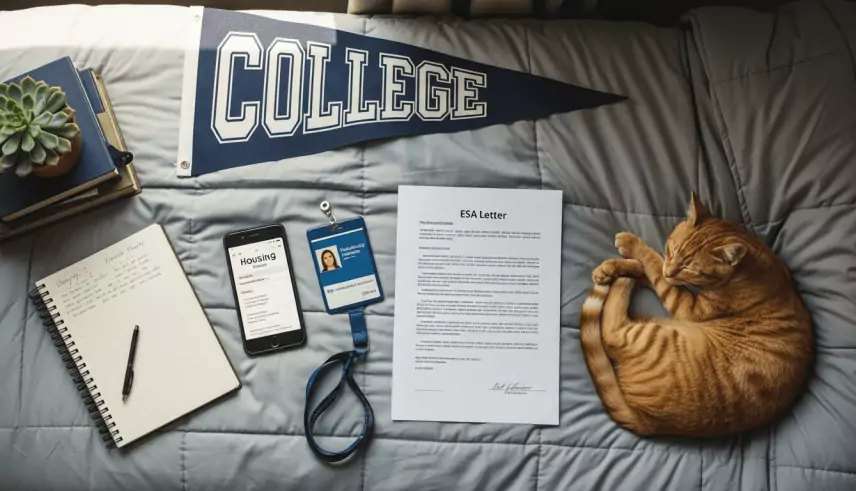

ESA Letter for College Students: Dorm Rights, Federal Laws, and How to Get Approved in 2026

by Alisha Shabbir
Last updated: March 10, 2026
Verified and Approved by:
Angela Morris,
MSW, LCSW
Fact Checked


- 37% of college students report moderate to severe depression, making ESAs a clinically relevant accommodation, not a loophole
- Under the Fair Housing Act, your school must allow your ESA in campus housing with zero pet fees, zero breed restrictions, and zero exceptions
- A valid ESA letter from a licensed mental health professional is the only documentation required (no registrations, vests, or certifications)
- Submit your accommodation request 3-4 months before move-in since schools like Yale require 60 days lead time
- If your college wrongfully denies your ESA, you can file a federal complaint with HUD. Settlements in student ESA cases have reached $140,000
You’re halfway through your freshman year, your anxiety is through the roof, and you’re Googling “can I bring my dog to college?” at 2 a.m. because your dorm room feels like a shoebox and your support system is 300 miles away. The good news? If you have a qualifying mental health condition and an ESA letter for college from a licensed professional, federal law says your school has to let your emotional support animal live with you in campus housing. No exceptions for “no pet” policies, no extra fees, no breed bans. This guide walks you through your exact legal rights as a college student with an ESA, how the approval process works, and what to do if your school pushes back.

Why College Students Need Emotional Support Animals
College is supposed to be the best four years of your life. Nobody mentions the part where you’re managing a full course load, adjusting to a completely new social environment, and doing it all without the support network you spent 18 years building at home. For students dealing with anxiety, depression, PTSD, or other mental health conditions, that transition can feel overwhelming.
Recent data backs this up. According to the 2024-2025 Healthy Minds Study, 37% of college students report moderate to severe depressive symptoms and 32% experience moderate to severe anxiety. More than half of students surveyed reported high levels of loneliness. And while those numbers have actually improved slightly from pandemic-era peaks, they’re still significantly higher than pre-2020 levels.
That’s the context behind the growing number of students requesting emotional support animals for housing. An ESA isn’t just a pet you happen to love. It’s an animal that a licensed professional has determined provides meaningful therapeutic benefit for a diagnosed condition. The companionship, routine, and calming presence of an ESA can reduce cortisol levels, boost oxytocin, and provide genuine stability during a period of life that’s defined by instability.
And here’s something worth knowing: research consistently shows that interaction with animals lowers stress hormones and blood pressure. For a college student coming back to their dorm after a brutal exam or a rough social interaction, having a familiar, comforting animal waiting there can make a measurable difference. It’s not just about “wanting a pet.” It’s a recognized component of mental health treatment.
ESA Rights in College Dorms: Fair Housing Act and Federal Law
Three federal laws are relevant to ESA rights on college campuses. Understanding each one gives you the ability to advocate for yourself if your school’s housing office gives you the runaround.
Fair Housing Act: ESA Housing Protection for Students
This is where the legal protections become important, and where a lot of colleges (and students) get confused. The primary law protecting your right to have an ESA in your dorm is the Fair Housing Act (FHA), a federal law that prohibits housing discrimination based on disability. It applies to virtually all types of housing, and yes, that includes college and university dormitories.
Under the FHA, colleges must provide “reasonable accommodations” for students with disabilities. If you have a qualifying mental health condition and an ESA letter from a licensed mental health professional, your school is required to let your emotional support animal live with you in campus housing. Period. It doesn’t matter if the dorm has a strict no-pet policy. An ESA is not legally considered a pet.
HUD issued updated guidance in 2020 (FHEO-2020-01) that clarifies exactly how housing providers, including universities, should handle ESA requests. Here’s what it means for you as a student:

Your college cannot charge you pet fees, pet deposits, or additional rent for having an ESA. Here’s what else they cannot do:
- Deny your ESA based on breed, weight, or size restrictions that would apply to regular pets
- Require your ESA to wear a vest, be registered with any service, or carry ID
- Demand access to your full medical records
A valid ESA letter is the only documentation required.
What they can do:
- Require the ESA letter to come from a licensed mental health professional who has personal knowledge of your condition
- Hold you responsible for any property damage caused by your ESA
- Require that the animal is under your control at all times
- Remove the animal if it poses a genuine direct threat to the health or safety of others
Section 504 of the Rehabilitation Act
Beyond the FHA, there’s another layer of protection. Section 504 of the Rehabilitation Act prohibits discrimination based on disability in any program receiving federal financial assistance. Since most colleges and universities receive federal funding (through financial aid programs, Pell Grants, research funding, etc.), Section 504 gives students additional grounds for accommodation requests.
This is worth knowing because Section 504 can apply beyond just housing in some cases. While the FHA specifically covers your dorm, Section 504 protections can extend to other aspects of your college experience where disability accommodations are needed. Some universities, like UW-Madison, have policies that explicitly recognize ESA accommodations under both the FHA and Section 504.
Americans with Disabilities Act (ADA)
The ADA primarily covers service animals (not ESAs) for public access. But it still matters for college students because it requires institutions to provide reasonable accommodations for students with disabilities in educational settings. Your ESA won’t have classroom access under the ADA, but the law reinforces the broader principle that your school cannot discriminate against you based on your disability.

Your ESA Dorm Rights: What Colleges Can and Cannot Do
This is where misconceptions run rampant, on both sides. Some students think an ESA letter means unlimited access everywhere on campus. Some colleges think they can apply pet rules to ESAs. Both are wrong.
Here’s what your college can and cannot require when reviewing your ESA documentation:
| Required (You Must Provide) | Not Required (College Cannot Ask) |
|---|---|
| ESA letter from licensed LMHP | Your specific diagnosis |
| Confirmation of disability-related need | Detailed medical records |
| Provider’s license number and state | Information about your treatment plan |
| Provider’s signature on letterhead | Records from your therapist or psychiatrist |
| Species, breed, and vaccination records for your animal | Proof of ESA training or certification |
| Accommodation request form (school-specific) | ESA registration, vest, or ID card |
Your school is required to:
- Allow your ESA in on-campus housing without penalties or extra fees
- Waive all pet deposits and pet rent
- Process your accommodation request within a reasonable timeframe (HUD guidance suggests 10 business days)
- Keep your disability information confidential, meaning they cannot share your diagnosis with RAs, roommates, or other staff beyond what’s necessary to process the accommodation
They cannot deny your ESA based on breed, weight, or size restrictions. They cannot require your ESA to wear a vest or be registered. And they cannot ask for your specific diagnosis or full medical records.
What they can do is hold you financially responsible for property damage, require the animal to be under your control at all times, and remove the ESA if it poses a documented direct threat to health or safety based on the animal’s actual behavior, not breed stereotypes. They can also deny the accommodation if your documentation comes from a provider with no genuine clinical relationship with you.
ESA vs. Service Animal vs. Pet: College Campus Rights Compared
One of the biggest sources of confusion on college campuses is the difference between an emotional support animal, a service animal, and a regular pet. The distinction matters because each category comes with different legal protections and access rights.
| Category | Dorm Access | Classroom Access | Training Required | Pet Fees | Legal Protection | Animal Types |
|---|---|---|---|---|---|---|
| Emotional Support Animal | Yes (FHA) | No | None | None (by law) | Fair Housing Act, Section 504 | Common household animals |
| Service Animal | Yes (ADA + FHA) | Yes (ADA) | Task-trained for specific disability | None (by law) | ADA + FHA + Section 504 | Dogs only (miniature horses in some cases) |
| Pet | Only if school allows | No | None | Yes, if permitted | None | School policy dependent |
A service animal under the ADA is a dog (or in rare cases, a miniature horse) that has been individually trained to perform specific tasks related to a person’s disability. Think guiding someone who is visually impaired, alerting someone to seizures, or performing grounding tasks during a PTSD episode. Service animals have full public access rights. They can go to classrooms, libraries, dining halls, and anywhere else on campus.
An emotional support animal doesn’t need any specific training. Its therapeutic value comes from its presence and companionship, which a licensed professional has determined helps alleviate symptoms of a diagnosed condition. ESAs are protected under the Fair Housing Act for housing, but they do not have public access rights under the ADA. That means your ESA can live with you in your dorm, but you generally cannot bring it to class, the campus library, or the dining hall.
A pet has no legal protections on a college campus. Most schools ban pets in dorms entirely, and those that allow them typically charge fees and impose breed or species restrictions.

Understanding this distinction protects you. If your school tries to apply pet rules to your ESA (like charging fees or imposing breed bans), you’ll know that’s a violation of the FHA. And if they claim only “service animals” are allowed, you can point to the HUD guidance (FHEO-2020-01) that explicitly requires colleges to accommodate assistance animals, including ESAs, in housing.
If you need an animal in classrooms and other campus buildings, you would need a psychiatric service dog, which requires specific task training and qualifies under the ADA for full public access.
How to Get an ESA Letter for College Housing
Getting an ESA letter is the single most important step in the process. Without it, your college has no obligation to accommodate your animal, and your request will almost certainly be denied. Here’s exactly how it works.
Step 1: Qualifying Conditions for a College ESA Letter
ESA letters are issued for individuals with a diagnosed mental or emotional health condition that substantially limits a major life activity. Common qualifying conditions include:
- Anxiety disorders (generalized, social, panic)
- Depression
- PTSD
- Bipolar disorder
- OCD
- ADHD (when significantly impacting daily functioning)
- Insomnia related to psychological conditions
If you’re unsure whether your condition qualifies, the evaluation itself will determine that. A licensed mental health professional assesses your specific situation during the consultation.
Step 2: Getting an ESA Evaluation From a Licensed Provider
Your ESA letter must come from a licensed mental health professional (LMHP) who is licensed to practice in your state. Qualifying providers include:
- Psychologists
- Psychiatrists
- Licensed clinical social workers (LCSWs)
- Licensed professional counselors (LPCs)
- Nurse practitioners with psychiatric specializations
You have two paths here. You can work with your existing therapist or counselor (if you already have one), or you can connect with a licensed provider through a telehealth service. Telehealth evaluations are legitimate and widely accepted. HUD’s own guidance confirms that licensed professionals delivering services remotely can provide valid ESA documentation, as long as they have personal knowledge of the individual’s condition.
During the evaluation, expect to discuss your mental health history, current symptoms, how your condition impacts your daily life, and how an ESA would specifically help alleviate those symptoms. It’s not a rubber stamp. The clinician needs to genuinely determine that an ESA is therapeutically appropriate for your situation.
Step 3: What a Valid ESA Letter Contains
If approved, you’ll receive an official ESA letter that includes:
- The provider’s name, license number, and state of licensure
- A statement that you have a disability that substantially limits a major life activity
- A professional determination that an ESA is necessary for your mental health
This letter is typically valid for 12 months and should be renewed annually.
One critical note: your college is within its rights to reject letters from providers who have no established relationship with you. HUD has specifically warned that documentation purchased from websites offering quick certificates without genuine clinical evaluation may not be considered reliable. Your ESA letter needs to come from a legitimate licensed professional who has conducted an actual assessment.
If you’re in a state like California, Arkansas, or Louisiana that requires a 30-day client-provider relationship before an ESA letter can be issued, factor that into your timeline.

Step 4: Submitting Your ESA Request to Your School
Once you have your ESA letter, contact your school’s disability services office (sometimes called accessibility services, student accommodations, or a similar name). Each college has its own process, but generally you’ll need to:
- Submit your ESA letter
- Fill out an accommodation request form
- Provide basic information about your animal (species, breed, vaccination records)
Timing matters. Many schools have specific deadlines for ESA accommodation requests, and processing times vary significantly:
| School | Deadline / Lead Time | Processing Notes |
|---|---|---|
| Yale University | 60 days before semester start | Cannot guarantee accommodations if submitted late |
| Princeton University | Before semester start (recommended early) | Requires two local emergency contacts for ESA |
| University of Wisconsin-Madison | As early as possible | References both FHA and Section 504 in policy |
| Most public universities | June 1 for fall, October 1 for spring (common) | 2-4 weeks typical processing time |
| State schools in 30-day states (CA, AR, IA, LA, MT) | Add 30 days for provider relationship | Begin the process 3-4 months before move-in |
Start this process as early as possible. Don’t wait until move-in week.
Step 5: Receive Approval and Move In
Your school will review your documentation and issue a decision, usually in writing. If approved, they’ll coordinate housing arrangements (you may be placed in a single room or matched with a roommate who consents to living with an animal). Once everything is in place, you’re free to move in with your ESA.
College Denied Your ESA? How to Appeal and File a Complaint
Colleges can deny an ESA accommodation under very specific, limited circumstances:
- The animal poses a documented direct threat to health or safety
- The accommodation would create an undue financial or administrative burden
- The documentation doesn’t meet requirements (for example, the letter is from an unlicensed provider or doesn’t establish a disability-related need)
But they cannot deny your request simply because of a no-pet policy, because other students or staff are uncomfortable with animals, or because of general breed restrictions.
How to Appeal an ESA Denial
If your school wrongfully denies your accommodation, you have options. Start by appealing through the school’s internal process. Most disability services offices have a formal appeals procedure. If that doesn’t work, you can file a complaint directly with HUD’s Office of Fair Housing and Equal Opportunity.
Courts have consistently sided with students in these disputes. In one case, a university settled for $140,000 after denying a student’s request to keep a miniature pinscher for chronic anxiety. Another school paid $100,000 in a lawsuit involving a couple denied an ESA in university housing. Your rights under the FHA are well-established, and schools that violate them face real consequences.
Living With an Emotional Support Animal in Your College Dorm
Getting approved is one thing. Making it work day-to-day in a dorm environment requires some planning.
ESA Roommate Rules in College Dorms
If you’re in a shared room, your school will typically try to match you with a roommate who agrees to live with an animal. Be upfront and communicate early. If your roommate has allergies or a fear of animals, the school should resolve this by reassigning rooms. They cannot, however, use a roommate conflict as a reason to deny your ESA accommodation entirely.
Some schools automatically place ESA students in single rooms. Others assign you to specific ESA-designated housing. Ask your disability services office about the options available at your school.

Best Emotional Support Animals for Dorm Rooms
Dorm rooms are small. While the FHA doesn’t restrict you to specific animal types (as long as it’s a common domesticated animal), practicality matters. Cats, small dogs, and smaller animals like rabbits or hamsters tend to work best in a dorm setting. Consider noise level, space requirements, exercise needs, and your daily schedule. A high-energy breed that needs hours of outdoor activity may not be the best fit for a 12×12 dorm room, even if it’s legally permitted.
Your Responsibilities as an ESA Owner
Your rights come with responsibilities. As an ESA owner on campus, you’re expected to:
- Keep your ESA under control at all times
- Clean up after your animal
- Ensure it’s vaccinated and healthy
- Prevent it from causing damage or disturbance to other residents
If your ESA creates a safety hazard, damages property, or significantly disrupts other residents, the school may have grounds to revoke the accommodation. Being a responsible ESA owner protects both your rights and the broader acceptance of ESAs on campus.
Where ESAs Are Allowed on College Campuses
Your ESA is allowed in your dorm room and the immediate areas needed to get your ESA outside (hallways, building exits). Beyond that, most campuses restrict ESAs from classrooms, dining halls, libraries, and other common areas. Your ESA should be on a leash or in a carrier whenever it’s outside your room. Some campuses have designated outdoor areas for ESA walking. Check your college’s ESA policy for building-specific rules.
State ESA Laws That Affect College Students
While the Fair Housing Act provides a federal baseline of protection, some states have additional laws that can impact your experience as a college student with an ESA.
30-Day ESA Letter Requirements by State
California, Arkansas, Iowa, Louisiana, and Montana now require a 30-day client-provider relationship before an ESA letter can be issued. If you attend school in one of these states (or are a resident), plan ahead. You’ll need to start the evaluation process at least a month before you need your letter.
ESA Fraud Penalties by State
Florida has enacted strict penalties for fraudulent ESA claims, so make sure your documentation is from a legitimate, licensed provider. Colorado, Maryland, and Virginia have similar anti-fraud provisions.
How to Handle State-Specific Requirements
Working with a provider who is familiar with both federal and state ESA regulations is the simplest approach. If you attend school in a different state than where you’re a resident, the state where you attend school (and where the housing is located) is generally the relevant jurisdiction for FHA purposes.
CONCLUSION
Your mental health matters, and you shouldn’t have to choose between getting help and getting an education. An ESA letter for college students gives you the legal backing to keep your support animal where it makes the biggest difference: right there with you in your dorm.
With 37% of students reporting moderate to severe depression and over half experiencing high levels of loneliness, you are far from alone in needing this support. The protections exist specifically so students like you don’t have to navigate college without the tools that help them function.
If you think you might qualify, start your ESA evaluation with Wellness Wag. Our licensed mental health professionals are available in all 50 states, and most students receive their ESA letter within 24-48 hours of their consultation.
FAQs
Can you have an emotional support animal in a college dorm?
Yes. Under the Fair Housing Act, colleges must allow emotional support animals in on-campus housing as a reasonable accommodation for students with qualifying mental health conditions. You’ll need a valid ESA letter from a licensed mental health professional. The school cannot charge you pet fees or deny your request based on a no-pet policy.
What qualifies you for an ESA letter as a college student?
You qualify if a licensed mental health professional determines that you have a mental or emotional health condition that substantially limits a major life activity and that an ESA would alleviate symptoms of that condition. Common qualifying conditions include anxiety, depression, PTSD, panic disorder, bipolar disorder, OCD, and ADHD when it significantly impacts daily functioning.
Can my college ask for my specific diagnosis or medical records?
No. Your college can require a valid ESA letter confirming you have a qualifying disability and need an ESA, but they cannot demand your specific diagnosis, detailed medical records, or other private health information beyond what the ESA letter contains. HUD guidance (FHEO-2020-01) is explicit about this. Your condition remains confidential.
Can I bring my ESA to class or the library?
Generally, no. ESAs are protected under housing law (the Fair Housing Act), not public access law (the ADA). Your ESA can live with you in your dorm but typically cannot accompany you to classrooms, libraries, or dining halls. If you need an animal in public campus spaces, you would need a trained psychiatric service dog that qualifies under the ADA.
How far in advance should I request ESA housing at my college?
Start as early as possible, ideally 3-4 months before your move-in date. Many colleges have specific deadlines (June 1 for fall and October 1 for spring is common) and some need up to 60 days to process requests and arrange housing placement. Factor in extra time if you’re in a state like California that requires a 30-day provider relationship before an ESA letter can be issued.
What happens if my roommate complains about my ESA?
Your school should resolve roommate conflicts by offering room reassignments, not by revoking your ESA accommodation. If your roommate has allergies, fears, or general discomfort with your animal, the housing office can move one of you to a different room. They cannot use a roommate’s complaint as a reason to deny or revoke your approved ESA accommodation. That said, keeping open communication with your roommate and ensuring your ESA is well-behaved goes a long way toward preventing conflicts.
Hey, I’m Alisha and I help ESA owners make sense of housing rights and mental health resources. At Wellness Wag, I write about Fair Housing laws, landlord requirements, and everything you need to know about living with an emotional support animal. I believe knowing your rights is the first step to protecting them. When I’m not breaking down ESA regulations, you’ll find me on long walks or binge-watching documentaries.
Certify Your Emotional Support Animal Today

- https://sph.umich.edu/news/2025posts/college-student-mental-health-third-consecutive-year-improvement.html
- https://www.hud.gov/helping-americans/assistance-animals
- https://www.hud.gov/sites/dfiles/PA/documents/AsstAnimalsGuidFS1-24-20.pdf
- https://www.hud.gov/program_offices/fair_housing_equal_opp/assistance_animals
Table of Content


Your Pet is More Than a Companion
An ESA Letter can give you the legal support to keep them close
Why You Can Rely on Us?
At Wellness Wag, we believe your pet deserves care rooted in both science and compassion. Each article is carefully researched, written in clear language for pet owners, and then reviewed by qualified professionals to ensure the information is evidence-based, current, and practical for real-life care. Our goal is to help you feel confident in making informed decisions about your pet’s health and well-being.
Reviewed by
Angela Morris, MSW, LCSW
Angela is a licensed clinical social worker with 20 years of experience in patient advocacy and community mental health. She has assisted numerous clients with ESA evaluations and brings a deep understanding of disability accommodations, ensuring that all information is accurate, supportive, and practical.

Written by :
Alisha Shabbir
Last Updated :
March 10, 2026