
Your ESA Rights in 2026: What HUD’s Policy Change Means

hud hero image new

If you have a real disability and a real ESA letter,
you still have your housing rights.

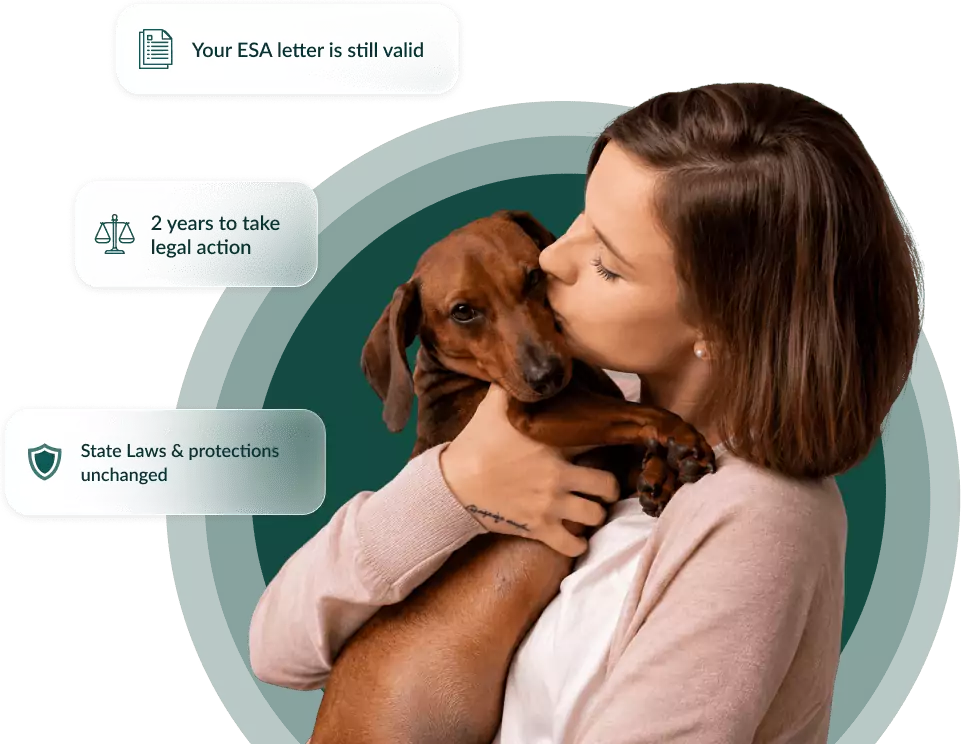
On May 22, 2026, HUD pulled its 2013 and 2020 guidance that told landlords to treat ESAs as assistance animals, creating widespread confusion and uncertainty. But it only changed how one federal agency handles ESA complaints. It did not repeal the Fair Housing Act. It did not make ESAs illegal. And it did not cancel your letter. Your landlord is still required to accept a reasonable accommodation request backed by a valid ESA letter from a licensed provider.

The honest breakdown

The 2026 HUD ESA Memo: What Changed Vs. What Didn’t

The change is narrower than the headlines made it sound. Here’s what was actually affected and what was not.

HUD’s Old Guidance is Gone

HUD permanently cancelled its 2013 and 2020 ESA guidance, the documents that told landlords to treat ESAs as assistance animals, not pets.

A New “Trained Task” Standard

For the complaints HUD pursues, it now looks for animals individually trained to do a specific, disability-related task, closer to the service-dog rule.

HUD Stepped Back From Enforcement

Staff were told to stop chasing complaints about untrained ESAs, and open cases are under review.

The Presumption Flipped

Before, an untrained ESA was presumed a reasonable accommodation. For HUD’s own enforcement, that presumption no longer applies.

The Fair Housing Act Itself

The federal law that makes disability discrimination in housing illegal (42 U.S.C. § 3604) has not been repealed, amended, or struck down. Congress did not vote on this. No court overturned it.

Your Right to Take Legal Action

You can still sue a landlord who denies your ESA in federal or state court within two years of the violation (42 U.S.C. § 3613). No agency needs to be involved.

Every State and Local Law

HUD’s memo does not override state or local fair housing laws, Section 504, or the ADA. Many states protect ESA owners well beyond the federal minimum.

Approvals You Already Have

If your landlord already approved your ESA, that accommodation stands. Nothing in the memo allows a landlord to revoke an existing reasonable accommodation.

How we got here

The Full Timeline Behind the 2026 HUD ESA Policy Change

Most coverage shows you one memo. Here’s the full 16-month sequence and the lawsuit working to reverse it.

Feb 2025

An executive order set the direction

The President directed federal agencies to pull back on enforcing rules that go beyond “the best reading of a statute.” This was the seed for everything that followed.

Sep 17, 2025

HUD withdraws its ESA guidance

HUD pulled its 2013 and 2020 assistance-animal notices, leaving how ESAs are handled under the Fair Housing Act unclear for several months.

Sep 2025

HUD pressures state agencies

HUD threatened to cut funding and referrals to state and local fair housing agencies that protect people beyond the federal minimum. This is what triggered the lawsuit below.

Dec 2025

The old guidance disappears from HUD.gov

The withdrawn notices were removed from HUD’s website, signaling the change was permanent.

Mar 16, 2026

16 states sue HUD

A coalition of 16 state attorneys general, co-led by California, sued HUD in federal court (Northern District of California), arguing the rollback is unlawful.

Case pending

Apr 2026

The change hits the Federal Register

HUD formalized the withdrawal through a published Federal Register notice.

May 22, 2026

The new enforcement memo arrives

FHEO Assistant Secretary Craig Trainor signed enforcement guidance effective immediately, cancelling the old ESA guidance and adopting the service dog “trained task” standard for complaints HUD pursues.

About that court case you may have heard about

“Henderson” does not mean landlords can deny your ESA.

You might see Henderson v. Five Properties cited as proof that landlords can now refuse emotional support animals. It does not say that. It was a narrow dispute over a pet fee in a single Louisiana federal court. The judge said each accommodation must be judged case by case, and gave less weight to HUD’s old guidance, following a 2024 Supreme Court decision (Loper Bright) that reduced how much courts defer to government agencies.

It is one court’s opinion, persuasive in some jurisdictions, binding nowhere nationwide. Other courts have continued siding with tenants. Bottom line: it narrowed the weight of HUD’s guidance, not your rights.

State by state

ESA Protections by State: What Your State Law Covers in 2026

The Fair Housing Act is the floor, not the ceiling. Many states protect ESA owners beyond what federal law requires. Here’s where six of the largest states stand.

StateYour state lawWho enforces itWhat it addsProtection
CaliforniaFair Employment & Housing Act (FEHA) + Disabled Persons ActCalifornia Civil Rights Department (CRD)Broader disability definition; AB 468 sets clear ESA documentation rules.Strong
New YorkNY State Human Rights Law (Exec. Law Art. 15); NYC Human Rights Law in NYCNYS Division of Human Rights; NYC Commission on Human RightsNYC requires a mandatory “cooperative dialogue” — among the most tenant-protective laws in the country.Strong
WashingtonLaw Against Discrimination (WLAD), RCW 49.60.222Washington State Human Rights CommissionWLAD expressly covers ESAs in housing; no small-landlord exemption for disability.Strong
FloridaFlorida Fair Housing Act, Fla. Stat. § 760.27Florida Commission on Human RelationsA dedicated ESA statute — § 760.27 is now the controlling roadmap for Florida landlords.Strong
TexasTexas Fair Housing Act (Tex. Prop. Code Ch. 301)Texas Workforce Commission, Civil Rights DivisionAn independent state complaint path, though the law largely mirrors the federal FHA.Moderate
ArizonaArizona Fair Housing Act (A.R.S. § 41-1491 et seq.)Arizona Attorney General, Civil Rights DivisionMirrors federal law, but the AG actively pursues ESA housing cases (recovered $2M+ in 2025).Moderate

Don’t see your state? The Fair Housing Act still applies everywhere, and nearly every state has its own enforcement agency. Check your state’s protections

If your landlord pushes back

ESA Letter Denied? Here’s What to Do

Some landlords are reading the headlines as a green light to deny ESA requests. They’re wrong and you have a clear path.

1

Don’t panic, and don’t move out

A denial isn’t the final word, and you have time. The headlines overstated what actually changed.

2

Re-request in writing, with your letter attached

Put your accommodation request in writing and include a current letter from a licensed provider. A paper trail is your strongest asset.

3

Go to your state agency

Your state or local fair-housing agency enforces independently of HUD. File your complaint there. Find yours in the table above.

4

Ask about Section 504

If your building receives any federal funding, Section 504 applies and the HUD memo does not affect it.

5

You can still sue

A fair housing attorney, legal aid office, or disability rights group can help, including filing a private lawsuit. You have two years from the violation to take a landlord to court (42 U.S.C. § 3613), regardless of what HUD does. Even the National Apartment Association tells landlords to review ESA requests case by case, not deny them outright.

The part people fear — but shouldn’t

Does Your ESA Already Qualify?

The new standard rewards animals that perform a specific, disability-related task. Many ESAs already do. Owners just never documented it. You do not need a professional trainer for this.

Alerting you before a panic attack
Grounding you during dissociation
Deep-pressure therapy during distress
Reminding you to take medication
Interrupting anxiety spirals
Guiding you to a safe space
Waking you from nightmares
Creating space for you in crowds
Detecting an episode before it starts

Important!

If your animal does any of these, your ESA letter should document it. A letter that describes specific support is far stronger in 2026 than a generic one.

The strongest protection

If your dog performs tasks, there’s a stronger document

HUD now follows the same standard the ADA uses to define a service animal. If your dog already performs trained tasks, a PSD letter will provide stronger protection for you.

ESA Letter

Protection in Your Home

Covers you in housing under the Fair Housing Act and your state’s law. No public-access rights. The right fit for comfort-based support that isn’t task-trained.

★ Strongest standing
PSD Letter — Psychiatric Service Dog

Full Federal Protection

Covers housing and public access, stores, restaurants, travel, under the ADA. Because HUD now applies the ADA’s trained-animal standard, a dog that meets it has the strongest housing protection available today.

An ESA letter covers housing. A PSD letter covers housing and public access under federal law. If your dog is already trained to perform disability-related tasks, the PSD path may be the strongest protection you can get in 2026.

FAQs

Yes. The memo changed how HUD handles complaints internally. It did not change the Fair Housing Act, which is the law your ESA letter is based on. A valid letter from a licensed mental health professional is still a legally recognized document.

Your landlord is still required to consider a reasonable accommodation request supported by a valid ESA letter. Denying one without an individualized assessment still violates the Fair Housing Act. If your landlord refuses, you can file with your state fair housing agency or take legal action directly.

For the complaints HUD itself investigates, it now requires the animal to be individually trained to perform a specific task related to the owner’s disability. This is similar to how the ADA defines service dogs. It does not apply to state agencies, courts, or private lawsuits.

Yes. You can file with your state or local fair housing agency, which enforces independently of HUD. You can also file a private lawsuit in federal or state court. You have two years from the date of the violation under 42 U.S.C. § 3613.

Yes. Our letters are issued by licensed mental health professionals based on real clinical evaluations, which is the standard courts and state agencies rely on. That said, if your letter is older or does not describe the specific ways your animal supports your condition, we recommend updating it. A letter that documents specific, disability-related support is significantly stronger under the 2026 standard than a generic one.

Why You Can Rely on Us?

At Wellness Wag, we believe your pet deserves care rooted in both science and compassion. Each article is carefully researched, written in clear language for pet owners, and then reviewed by qualified professionals to ensure the information is evidence-based, current, and practical for real-life care. Our goal is to help you feel confident in making informed decisions about your pet’s health and well-being.

Reviewed by

Angela Morris, MSW, LCSW

Angela is a licensed clinical social worker with 20 years of experience in patient advocacy and community mental health. She has assisted numerous clients with ESA evaluations and brings a deep understanding of disability accommodations, ensuring that all information is accurate, supportive, and practical.


angela morris bg trans