
ESA vs Service Dog vs. Therapy Dog: What’s the Difference?

by Nida Hammad
Last updated: July 9, 2026
Verified and Approved by:
Angela Morris,
MSW, LCSW
Fact Checked


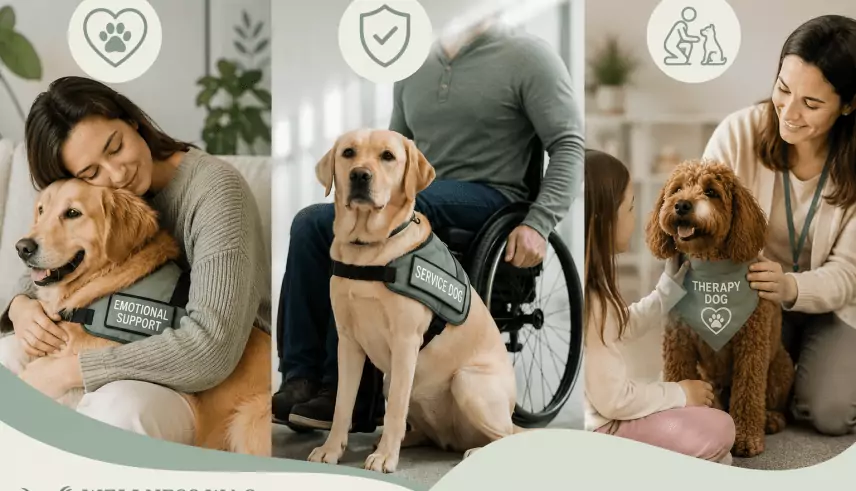
- The biggest difference between an emotional support animal (ESA) and a service dog is that service dogs are specially trained to help people with disabilities by doing certain tasks. ESAs help people by giving comfort and emotional support through companionship.
- ESAs are protected by the Fair Housing Act. This means landlords must usually allow your ESA to live with you, even if the building normally does not allow pets.
- Therapy dogs do not have special federal rights to go into public places. They can only work in places like hospitals or schools when they are invited.
- You do not need to register or certify your ESA. What you do need is a valid ESA letter from a licensed mental health professional.
- If you think you may qualify for an ESA, Wellness Wag can connect you with licensed doctors in all 50 states through a simple and HIPAA-compliant process.
ESA vs Service Dog: Understanding the Core Legal Definitions
The most important thing to understand about the ESA vs. service dog debate is that U.S. law treats them very differently. The Americans with Disabilities Act (ADA) is the federal law that covers service dogs. The Fair Housing Act (FHA) is the law that has historically protected ESAs in housing — though that protection changed significantly in May 2026.
Under the Americans with Disabilities Act (ADA), a service animal is a dog that is specially trained to help a person with a disability. The dog must perform specific tasks or jobs that directly help with the person’s disability. Dogs that only provide comfort, companionship, or emotional support are not considered service animals under the ADA.
An emotional support animal is not required to perform any specific task. It provides therapeutic benefit through companionship. Any species can qualify, not just dogs. Historically, the Fair Housing Act protected ESAs in housing, requiring landlords to accommodate them regardless of pet policies. However, on May 22, 2026, HUD issued enforcement guidance rescinding its 2013 and 2020 ESA guidance. Under the new policy, HUD will only pursue fair housing complaints involving animals that have been individually trained to perform tasks directly related to a person’s disability, the same standard the ADA uses for service animals. The Fair Housing Act itself was not changed by Congress, and state fair housing laws in many states continue to protect ESAs. But at the federal enforcement level, untrained ESAs no longer carry the same housing protections they held before May 2026.
What Counts as a “Task” for a Service Dog?
A task is a trained behavior that directly helps a person manage their disability. The dog must learn and perform this task on purpose. It cannot be something the dog does naturally.
Examples of trained tasks include:
- Guiding a person who is blind or has low vision through traffic and around obstacles
- Alerting a person who is deaf or hard of hearing to sounds like doorbells, smoke alarms, or a crying baby
- Pulling a wheelchair or helping a person move from one place to another
- Detecting the onset of a seizure and helping the person remain safe during the seizure
- Reminding a person with a psychiatric disability to take their medication at the right time
- Interrupting harmful or repetitive behaviors in a person with psychiatric disabilities
- Alerting a person with PTSD to an oncoming anxiety or panic attack through a trained physical behavior such as nudging or pawing
- Retrieving dropped items or opening doors for a person with limited mobility
Can Any Animal Be an ESA?
Yes. ESAs are not limited to dogs. Cats, rabbits, birds, and even miniature pigs can qualify as ESAs if a licensed mental health professional determines the animal supports the person’s mental health needs.
However, housing protections for ESAs changed in May 2026. HUD now requires that an animal be individually trained to perform tasks related to a person’s disability in order for a federal fair housing complaint to move forward. This brings the federal enforcement standard for ESAs in line with the ADA’s trained service animal standard.
That said, the Fair Housing Act itself has not changed. ESA letters from licensed mental health professionals are still valid. State fair housing laws also remain in place and are not affected by HUD’s new federal enforcement position. Tenants can also still pursue private lawsuits in federal or state court without needing a prior HUD finding. Section 504 of the Rehabilitation Act, which covers public housing and HUD-assisted housing, is also unaffected by the May 2026 memo.
This is one of the biggest practical differences in the ESA vs. service dog comparison. ESA status is based on the person’s documented mental health need, not the animal’s training. What changed in May 2026 is not the law but which agency will investigate your complaint if a landlord refuses.
ESA vs Service Dog: What Laws Apply to Each?
Understanding the legal framework is essential. Three major federal laws govern these animals, and they do not all overlap.
The Americans with Disabilities Act (ADA)
The ADA covers service dogs in public spaces. Businesses, restaurants, hotels, hospitals, and government buildings must allow service dogs to enter with their handlers. Under the ADA, staff may only ask two questions when it is not obvious the animal is a service dog: Is this a service animal required because of a disability? What work or task has the dog been trained to perform? Staff cannot ask about the person’s disability, ask for paperwork, or require the dog to demonstrate its task.
ESAs do not have public access rights under the ADA. A coffee shop or grocery store can legally turn away an ESA. The ADA only recognizes animals that are trained to perform a specific task tied to a disability. Comfort through presence alone does not meet that standard.
The Fair Housing Act (FHA)
Under the FHA, housing providers have historically been required to make reasonable accommodations for both service dogs and ESAs. However, this changed at the federal enforcement level on May 22, 2026. According to HUD’s assistance animals guidance, an assistance animal is one that works, provides assistance, or performs tasks for the benefit of a person with a disability, or that provides emotional support that alleviates one or more identified effects of a person’s disability. Assistance animals are not pets.
Under HUD’s May 22, 2026 enforcement guidance, HUD will now only pursue fair housing complaints involving animals that have been individually trained to perform disability-related tasks. The Fair Housing Act statute has not been amended by Congress, and tenants can still file private lawsuits and state-level complaints. But federal enforcement through HUD now applies the same trained animal standard as the ADA. Where a valid ESA letter and documented disability are present, a housing provider is still legally required under the FHA to consider the accommodation request, HUD simply will no longer be the agency that enforces it. This means:
- They cannot charge pet deposits or pet fees for your assistance animal
- They cannot deny housing solely because of a no-pet policy
- They must review each accommodation request on an individual basis
A housing provider may ask for documentation if the disability and the need for the animal are not obvious. If you have a documented disability and a valid ESA letter from a licensed mental health professional, your rights under the FHA remain intact through private litigation and state fair housing agencies.
The Air Carrier Access Act (ACAA)
As of January 11, 2021, the U.S. Department of Transportation updated its rules under the ACAA. ESAs are no longer recognized as service animals for air travel. Airlines may treat ESAs as regular pets, which means standard pet fees and carrier requirements apply.
Only trained psychiatric service dogs (PSDs) qualify for in-cabin access without pet fees. A PSD must be individually trained to perform a task that directly helps with a psychiatric disability. An ESA letter alone does not meet the DOT standard for air travel. To fly with a PSD, most airlines require passengers to complete the U.S. DOT Service Animal Air Transportation Form before the flight. This is a key distinction for travelers who rely on an assistance animal.
ESA vs Service Dog: Training Requirements
This is one of the most misunderstood differences between service dogs and ESAs.
Service dogs require individual training to perform specific tasks. There is no federal certification required, but the dog must be trained to do work that is directly tied to the handler’s disability. According to the AVMA, a dog is considered a service animal if it is trained to do specific tasks related to a person’s disability, regardless of whether it has been licensed or certified by a government agency or training program. Many service dogs go through months or years of training. Some are trained by professional organizations. Others are trained by the handler.
The key distinction is task. If the animal is trained to perform a specific function that helps manage a disability, it is a service dog. If the animal provides comfort through presence alone, it is an ESA, not a service dog.
ESAs require no formal training at all. The only requirement is a valid ESA letter from a licensed mental health professional. That letter documents that the person has a disability and that the animal provides therapeutic benefit for their condition.
This difference matters in real life. A service dog handler is not required to show any documentation in public. An ESA owner may need to show a valid ESA letter in a housing context when the disability is not obvious, as outlined under HUD’s Fair Housing guidance.
- Can Your Pet Become an ESA Without Any Training?
Yes. Your current pet can qualify as an ESA if a licensed mental health professional determines that the animal provides therapeutic benefit for your diagnosed condition. The pet does not need to pass any test or complete any training program.
The ESA letter must come from a real, licensed professional who has evaluated you. If you are ready to find out if you qualify, start your ESA evaluation with Wellness Wag today and connect with a licensed physician who can assess your individual situation.
What Is a Therapy Dog? How It Differs from ESA vs Service Dog
A therapy dog is not the same as a service dog or an ESA. Therapy dogs are trained to provide comfort and affection to people in places like hospitals, schools, nursing homes, and disaster relief areas. They visit those locations as volunteers with their handlers.
The key difference is this: therapy dogs serve groups of people in public settings, not one specific person with a disability. A therapy dog may comfort patients in a hospital ward. An ESA or service dog serves one specific person who has a documented disability.
- How Do Therapy Dogs Get Certified?
Therapy dogs go through an evaluation and registration process. The evaluation checks the dog’s temperament and the handler’s ability to work safely with the animal in facility settings. There is no federal certification for therapy dogs, but most facilities require proof of registration from a recognized organization before allowing a team to visit.
- Can Therapy Dogs Go Anywhere?
No. This is a common misconception. Therapy dogs can only visit facilities where they have been invited and where the facility has approved the program. They have no independent right of access to public spaces. A therapy dog cannot board an airplane for free or live in no-pet housing based on therapy dog status alone.
If you need housing protections for your animal, those rights come from the Fair Housing Act, which covers service dogs and ESAs, not therapy dogs. If you need in-cabin air travel access, only a trained psychiatric service dog qualifies under the DOT’s current rules.
ESA vs Service Dog vs Therapy Dog: Side-by-Side Comparison
| Feature | Service Dog | ESA | Therapy Dog |
| Legal definition | ADA: trained to do work/tasks for a person with a disability | FHA/HUD: provides emotional support for a person with a disability | No federal definition; registered by private organizations |
| Training required | Yes, individually trained for specific tasks | No training required | Evaluation for temperament; no task training required |
| Species allowed | Dogs only (plus miniature horses under ADA) | Any species | Dogs most common; Pet Partners accepts 9 species |
| ADA public access | Yes, full access to public places | No | No |
| FHA housing rights | Yes | Yes | No |
| Airline access (ACAA) | Trained service/psychiatric service dogs only | No (as of 2021) | No |
| Documentation needed | None required by ADA | ESA letter from licensed mental health professional | Organization registration certificate |
| Who benefits | One specific handler with a disability | One specific handler with a disability | Groups of people in facilities |
| Pet fees/deposits | Not allowed in housing | Not allowed in housing | N/A |
ESA vs Service Dog: Housing Rights Under the Fair Housing Act
Housing is where ESAs have their strongest legal protection. Under the Fair Housing Act, a housing provider must allow a reasonable accommodation for an assistance animal when a person with a disability requests it and the disability-related need is supported by reliable information.
This means that even if a building has a strict no-pets policy, the landlord cannot automatically deny you because you have an ESA. They must consider your individual request.
What housing providers can do:
- Ask for documentation if your disability is not obvious
- Request a letter from a licensed healthcare professional
- Deny the request if it would impose an undue burden or fundamentally alter the housing operation
- Ask about the disability-related need for the animal (not about the details of your diagnosis)
What housing providers cannot do:
- Charge extra fees or pet deposits for your ESA
- Deny housing based solely on a no-pet policy
- Ask about the specific details of your disability or medical records
- Require your ESA to be trained or certified
This is an important distinction in the emotional support animal vs service animal debate. Both have housing rights. Neither can be charged pet fees. But the documentation requirements differ.
- What Is a Valid ESA Letter?
A valid ESA letter must come from a licensed mental health professional or licensed physician. It must confirm that you have a diagnosed mental health condition and that the animal provides therapeutic support. The letter must be on official letterhead and include the provider’s license information.
Letters from ESA registration websites that do not involve an actual clinical evaluation are not considered reliable by housing providers. The FHA requires documentation from a real healthcare professional who has evaluated you.
ESA vs Service Dog: Public Access Rights
This is perhaps the most important practical difference for people who want to bring their animals into stores, restaurants, or other public places.
Service dogs have broad public access rights under the ADA. They can accompany their handlers virtually anywhere the public is allowed, including restaurants, hospitals, stores, hotels, and government buildings. A business can only exclude a service dog if it is out of control and the handler cannot regain control, or if the dog is not housebroken.
ESAs have no such right under federal law. A business is not required to admit an ESA. Some states have enacted additional protections, but at the federal level, ESAs do not have ADA public access rights.
The ASPCA’s position on service, assistance, and emotional support animals notes that cdifferent parts of the government have different rules for service animals and emotional support animals (ESAs). Because the rules do not match, it is very easy for businesses and the public to get confused.
For people with psychiatric disabilities, this distinction can feel unfair. A person with PTSD whose dog is trained to interrupt anxiety attacks has a psychiatric service dog (PSD) with full ADA public access rights. A person with depression who benefits from their cat’s companionship has an ESA with housing rights but no public access rights.
ESA vs Service Dog: Types of Support Animals Explained

The landscape of support animals is broader than most people realize. Here is a breakdown of the main types.
Guide Dogs Guide dogs are service dogs trained to help people who are blind or have low vision. They navigate obstacles, stop at curbs, and help their handlers move safely through the world. They have full ADA public access rights.
Hearing Dogs Hearing dogs are trained to alert their handlers to specific sounds, such as doorbells, smoke alarms, crying babies, or approaching cars. They are service dogs with full ADA rights.
Psychiatric Service Dogs (PSDs) PSDs are trained to help people with psychiatric or mental health disabilities. Tasks can include deep pressure therapy, interrupting self-harming behaviors, room searches for people with PTSD, and medication reminders. PSDs are service dogs and have full ADA rights. This is a critical distinction in the ESA vs service dog conversation for people with mental health conditions.
Emotional Support Animals (ESAs) ESAs provide therapeutic comfort to a specific person with a diagnosed mental health condition. They do not need training. Under the Fair Housing Act, they have historically had housing protections, though HUD’s May 2026 enforcement guidance narrowed federal enforcement to trained service animals. State fair housing laws and private litigation still provide avenues for ESA holders. ESAs do not have ADA public access rights.
Therapy Animals Therapy animals visit groups of people in institutional settings. They have no federal legal rights to access spaces. They work under the supervision of their handlers and the facilities they visit.
Facility Dogs Facility dogs are professionally trained dogs assigned to work with a specific person in a facility setting, such as a therapist in a school or a court advocate. They are distinct from therapy dogs and often have task training similar to service dogs.
Common Misconceptions About ESA vs Service Dog Status
- Myth: You can register your ESA online and get a vest or ID card.
- Reality: There is no official federal registry for ESAs. Vests, ID cards, and certificates sold online have no legal standing. The only document that matters is an ESA letter from a licensed professional who has evaluated you.
- Myth: Therapy dog certification gives your dog public access rights.
- Reality: Therapy dog registration through Pet Partners or a similar organization does not grant federal public access rights. Your therapy dog cannot accompany you to a restaurant or grocery store based on therapy dog status.
- Myth: All service dogs must be professionally trained.
- Reality: The ADA does not require professional training for service dogs. There is no certification program mandated by the federal government. An owner-trained service dog is fully recognized under current federal law. What matters is that the dog can reliably perform the trained task.
- Myth: ESAs can fly in the cabin for free.
- Reality: Since the 2021 changes to the ACAA, airlines are not required to accommodate ESAs as service animals. Most major airlines now treat ESAs as pets and charge pet fees.
- Myth: Landlords can always deny ESA requests.
- Reality: The Fair Housing Act statute still requires housing providers to consider reasonable accommodation requests for assistance animals. Denying a valid request without a legally justified reason can expose a landlord to liability through private litigation or state fair housing agencies. However, since May 22, 2026, HUD will no longer pursue federal complaints on behalf of tenants with untrained ESAs. State agencies and private lawsuits remain available options.
Conclusion
The ESA vs service dog distinction is not just a matter of labels. It determines where your animal can go, what documentation you need, and what legal protections apply to you. Service dogs are trained working animals with broad public access rights under the ADA. ESAs are companion animals with housing protections under the FHA. Therapy dogs serve groups of people in facilities and have no independent federal access rights.
If you have a mental health condition and believe an emotional support animal vs service animal could help you, the first step is an honest evaluation with a licensed professional. You do not need to register your animal or buy a vest. You need a valid letter that reflects a real clinical assessment of your needs.
Understanding types of support animals and which legal category applies to your situation protects you from misinformation and helps you advocate for your rights confidently. The ESA vs service dog distinction is clear once you understand the legal framework behind it.
If you are ready to take that step, complete your ESA eligibility evaluation with Wellness Wag and get connected to a licensed physician who can provide a legitimate, HIPAA-compliant ESA letter accepted under the Fair Housing Act.
Frequently Asked Questions
What is the main difference between an ESA vs service dog?
A service dog is trained to perform specific tasks for a person with a disability and has ADA public access rights. An ESA provides emotional comfort through companionship and has housing protections under the FHA but not ADA public access rights. Training is required for service dogs. No training is required for ESAs.
Can a service dog also be an ESA?
Technically, any dog that provides emotional support is also providing that benefit. But legally, an animal is classified by its primary function and the documentation backing it. A dog trained to perform disability-related tasks qualifies as a service dog. If the same dog also provides emotional comfort, the owner does not need a separate ESA designation for housing.
Do I need to register my emotional support animal?
No. There is no official federal registration system for ESAs. Any website claiming to provide an official ESA certificate or registration is not providing a legally valid document. What you need is an ESA letter from a licensed mental health professional or physician.
Can a therapy dog become a service dog?
A therapy dog can be trained to perform specific tasks for a person with a disability and become a service dog. But therapy dog registration alone does not make an animal a service dog. The dog must be individually trained to perform tasks related to a specific person’s disability.
Are ESAs allowed in all housing?
ESAs are protected in most housing covered by the Fair Housing Act. This includes most apartments, condominiums, cooperatives, and single-family homes rented through a landlord. It does not cover owner-occupied buildings with four or fewer units where the owner lives in one of the units.
Can any animal be an ESA?
Yes. ESAs can be cats, dogs, rabbits, birds, or other species. The animal does not need to be a dog. The key requirement is that the owner has a documented mental health condition and a licensed professional has determined the animal provides therapeutic benefit.
What happens if a landlord denies my ESA request?
If you have a valid ESA letter and the landlord refuses to make a reasonable accommodation, this may be a violation of the Fair Housing Act. You can file a complaint with HUD or your local fair housing organization.
Is a psychiatric service dog the same as an ESA?
No. A psychiatric service dog (PSD) is a service dog trained to perform specific tasks for a person with a psychiatric disability, such as PTSD or severe anxiety. PSDs have full ADA public access rights. ESAs do not. PSDs can also fly in the cabin under ACAA rules. ESAs generally cannot.
Hi, I’m Nida, a writer and proud member of the Wellness Wag team. I’m passionate about sharing insights on how therapy dogs and emotional support animals can enhance emotional health, comfort, and overall well-being.
Certify Your Emotional Support Animal Today

- U.S. Department of Justice. (2020, February 28). ADA requirements: Service animals. ADA.gov. https://www.ada.gov/resources/service-animals-2010-requirements/
- U.S. Department of Justice. (2010). Fact sheet: Highlights of the final rule to amend the Department of Justice’s regulation implementing Title II of the ADA. archive.ada.gov. https://archive.ada.gov/regs2010/factsheets/title2_factsheet.html
- U.S. Department of Justice. (2010). Fact sheet: Highlights of the final rule to amend the Department of Justice’s regulation implementing Title III of the ADA. archive.ada.gov. https://archive.ada.gov/regs2010/factsheets/title3_factsheet.html
- U.S. Department of Housing and Urban Development. (2025). Assistance animals. HUD.gov. https://www.hud.gov/helping-americans/assistance-animals
- U.S. Department of Housing and Urban Development. (2020, January 28). Notice FHEO-2020-01: Assessing a person’s request to have an animal as a reasonable accommodation under the Fair Housing Act. HUD.gov. https://www.hud.gov/sites/dfiles/PA/documents/HUDAsstAnimalNC1-28-2020.pdf
- American Veterinary Medical Association. (2022). Service, emotional support, and therapy animals. AVMA.org. https://www.avma.org/resources-tools/animal-health-and-welfare/service-emotional-support-and-therapy-animals
- American Veterinary Medical Association. (2022). Assistance animals: Rights of access and the problem of fraud. AVMA.org. https://avma.org/sites/default/files/resources/Assistance-Animals-Rights-Access-Fraud-AVMA.pdf
- American Society for the Prevention of Cruelty to Animals. (n.d.). Service, assistance and emotional support animals. ASPCA.org. https://www.aspca.org/about-us/aspca-policy-and-position-statements/service-assistance-and-emotional-support-animals
- Pet Partners. (2023). A beginner’s guide to animal-assisted intervention terminology. PetPartners.org. https://petpartners.org/a-beginners-guide-to-animal-assisted-intervention-terminology/
- Pet Partners. (2023). Therapy animal program requirements. PetPartners.org. https://petpartners.org/volunteer/requirements/
- Brooks, H. L., Rushton, K., Lovell, K., Bee, P., Walker, L., Grant, L., & Rogers, A. (2018). The power of support from companion animals for people living with mental health problems: A systematic review and narrative synthesis of the evidence. BMC Psychiatry, 18(1), 31. https://www.ncbi.nlm.nih.gov/pmc/articles/PMC5800290/
- National Institutes of Health. (2018, February). The power of pets. NIH News in Health. https://newsinhealth.nih.gov/2018/02/power-pets
- Younggren, J. N., Boisvert, J. A., & Boness, C. L. (2020). Examining emotional support animals and role conflicts in professional psychology. Professional Psychology: Research and Practice, 51(5), 394-402. https://pubmed.ncbi.nlm.nih.gov/32982035/
- U.S. Department of Justice. (n.d.). Service animals. ADA.gov. https://www.ada.gov/topics/service-animals/
Table of Content


Your Pet is More Than a Companion
An ESA Letter can give you the legal support to keep them close
Why You Can Rely on Us?
At Wellness Wag, we believe your pet deserves care rooted in both science and compassion. Each article is carefully researched, written in clear language for pet owners, and then reviewed by qualified professionals to ensure the information is evidence-based, current, and practical for real-life care. Our goal is to help you feel confident in making informed decisions about your pet’s health and well-being.
Reviewed by
Angela Morris, MSW, LCSW
Angela is a licensed clinical social worker with 20 years of experience in patient advocacy and community mental health. She has assisted numerous clients with ESA evaluations and brings a deep understanding of disability accommodations, ensuring that all information is accurate, supportive, and practical.

Written by :
Nida Hammad
Last Updated :
July 9, 2026