

Can You Have ESA letter for college dorm? A 2026 Guide to On-Campus Housing Rights

by Nida Hammad
Last updated: May 25, 2026
Verified and Approved by:
Angela Morris,
MSW, LCSW
Fact Checked


- Federal law says your college must allow your emotional support animal (ESA) to live with you in the dorm if you have a valid ESA letter from a licensed mental health professional.
- After you give the correct documents, your school cannot charge pet fees, ban certain animal breeds, or refuse your ESA because of a “no pets” rule.
- An ESA letter must be written by a licensed mental health professional who has personally checked and talked with you. Online registrations or certificates are not accepted.
- If your college wrongly refuses your ESA request, you can make a free complaint to HUD (the U.S. Department of Housing and Urban Development). Some students have received settlements of up to $140,000 in ESA cases.
- Send your ESA letter to the disability services office at least 4 to 6 weeks before moving into the dorm so there is enough time to process it.
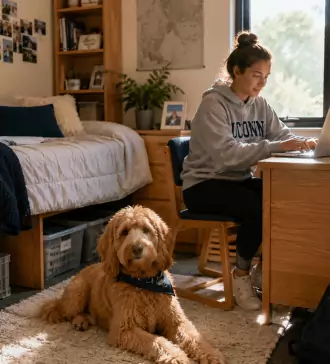
Yes, you can keep an emotional support animal (ESA) in a college dorm. This is not just a special favor from your school. It is a right protected by federal law.
The main law is called the Fair Housing Act (FHA). Under this law, college dorms are treated like housing providers, just like landlords. This means colleges must follow the same housing rules. If you have a mental health condition and a valid ESA letter for college housing, your school must allow your ESA to live with you.
The U.S. Department of Housing and Urban Development (HUD) is the government agency that enforces this law. HUD says that housing providers must make reasonable changes for people with disabilities when needed. An emotional support animal in a dorm is seen as a reasonable accommodation, not as a pet.
Another federal law also protects students with disabilities. It is called Section 504 of the Rehabilitation Act of 1973. This law says schools that get federal funding cannot treat people unfairly because of a disability. Almost all colleges in the United States receive federal funding. The Office for Civil Rights in the U.S. Department of Education makes sure colleges follow this law.
Together, these laws help protect your right to have an ESA in college housing.
What the Law Says Your College Cannot Do
- Your college cannot charge you pet fees or deposits for your emotional support animal (ESA). An ESA is not treated like a regular pet under the law.
- Your school cannot refuse your ESA because of its breed, size, or weight. Rules for normal pets do not apply to ESAs.
- Your ESA does not need a special vest, ID card, or online registration. The main document you need is a valid ESA letter from a licensed mental health professional.
- Your college cannot ask for your full medical records or detailed health history. They can only ask for proof that you need the ESA for support.
- Your school cannot ignore your request. In most cases, colleges should reply within 10 days after getting your ESA documents.
Who Qualifies for an ESA letter for college dorm
- To get an ESA letter for college housing, you must have a mental or emotional health condition that affects your daily life. A licensed mental health professional must confirm this condition.
- Common conditions that may qualify include anxiety, depression, PTSD, ADHD, OCD, bipolar disorder, and strong fears called phobias. You cannot diagnose yourself.
- Many college students face these problems.According to the 2024-2025 Healthy Minds Study, conducted across 135 colleges and universities, 37% of college students report moderate to severe depressive symptoms and 32% experience moderate to severe anxiety.
- Your condition does not need to be very severe. It only needs to affect your daily activities in a meaningful way.
- A licensed mental health professional will talk with you and decide if an emotional support animal can help improve your mental health and daily life.
What Makes a Valid ESA Letter for College Housing
A valid ESA letter must include these important details:
- The letter must be written on the official paper of a licensed mental health professional.
- It must include the provider’s full name, license type, license number, and the state where they are licensed.
- The letter must have the provider’s contact information and signature.
- It must clearly say that you have a mental or emotional health condition.
- The letter must explain that the emotional support animal (ESA) is part of your treatment or support plan.
- The letter must include the date. Most ESA letters are valid for one year.
If you need a valid ESA letter then, working with a licensed professional who has a real therapeutic relationship with you is the correct path. Wellness Wag connects students with licensed mental health professionals for legitimate ESA evaluations. Get started today and have your letter ready before the school year begins.
How to Get Your ESA Letter Approved in a College Dorm: Step by Step

Step 1: ESA letter for College Dorm
Talk to a licensed mental health professional, such as a therapist or psychologist. They will check your condition and decide if an ESA can help you. If approved, they will give you an official ESA letter.
Step 2: Submit Your Request
Send your ESA letter to your college’s disability services office. Some schools may also ask you to contact the housing office. Always check your school’s process first.
Step 3: Apply Early
Submit your request at least 4 to 6 weeks before moving into the dorm. Some colleges need extra time to review ESA requests.
Step 4: Follow the Review Process
Your college may check if your provider has a valid license. They can ask questions about why you need the ESA, but they cannot ask for your full medical records or diagnosis.
Step 5: Get Written Approval
If your request is accepted, the college should give you written approval. Keep this document safe in case any problems happen later.
Step 6: Take Care of Your ESA
Your ESA must behave properly, stay clean, and remain under your control. You must also pay for any damage caused by the animal. If these rules are not followed, the school may remove the ESA from the dorm
What to Do If Your College Denies Your ESA Letter Request
- If your college rejects your ESA request, ask them to give the reason in writing. This helps keep a record and may make the school review the decision again.
- Read the denial carefully. Some schools wrongly reject ESAs because of “no pets” rules, breed limits, or extra fees, even though these reasons may break the law.
- If you think the denial is unfair, you can file a free complaint with HUD through their website. HUD can investigate the case and ask the school to fix the problem.
- You can also complain to the U.S. Department of Education under Section 504. Colleges that break the rules could lose federal funding.
- If the situation becomes difficult, a lawyer who knows fair housing laws can help you understand your rights and support your case.
Conclusion
Your right to keep an emotional support animal (ESA) in a college dorm is protected by federal law. The Fair Housing Act says colleges must make reasonable changes for students with disabilities. A valid ESA letter from a licensed mental health professional helps protect this right.
Rules like “no pets,” breed limits, or pet fees usually do not apply to ESAs. To avoid problems, get a real ESA letter, send it to your school’s disability services office, and apply early.
If your college refuses your request without a valid reason, you can take action. Filing a complaint with HUD is free, and many colleges take these complaints seriously.
Ready to get started? Wellness Wag makes it simple to connect with a licensed mental health professional and get a valid ESA letter. Take the first step today so you are prepared before move-in day.
Frequently Asked Questions
Can my college charge extra for housing if I have an ESA?
No. Your college cannot charge pet fees, deposits, or extra rent for an emotional support animal (ESA). They also cannot force you to stay in a more expensive dorm because of your ESA.
Can I have more than one ESA in my dorm?
Yes, but each animal must be medically needed. A licensed mental health professional must explain why you need more than one ESA.
Can my roommate object to my ESA?
A roommate’s personal dislike does not cancel your ESA rights. But if a roommate has a serious allergy, the school may move one of the students to another room.
What if my ESA causes damage to the dorm room?
You must pay for any damage your ESA causes to the dorm, beyond normal use. The school can ask you to cover repair costs.
Do ESAs have access to campus buildings outside the dorm?
No. Federal law only protects ESA access in housing areas like dorms. Colleges do not have to allow ESAs in classrooms, libraries, or dining halls.
Hi, I’m Nida, a writer and proud member of the Wellness Wag team. I’m passionate about sharing insights on how therapy dogs and emotional support animals can enhance emotional health, comfort, and overall well-being.
Certify Your Emotional Support Animal Today

- · U.S. Department of Housing and Urban Development. (2020, January 28). Assistance animals [Guidance document]. https://www.hud.gov/helping-americans/assistance-animals
- · U.S. Department of Housing and Urban Development. (2020). Assessing a person’s request to have an animal as a reasonable accommodation under the Fair Housing Act (FHEO Notice 2020-01). https://www.hud.gov/sites/dfiles/PA/documents/AsstAnimalsGuidFS1-24-20.pdf
- · U.S. Department of Housing and Urban Development. (2020, January 28). HUD issues guidance on reasonable accommodations under the Fair Housing Act relating to assistance animals [Press release]. https://archives.hud.gov/news/2020/pr20-013.cfm
- · U.S. Department of Education, Office for Civil Rights. (2025, January 14). Disability discrimination: Overview of the laws. https://www.ed.gov/laws-and-policy/civil-rights-laws/disability-discrimination/disability-discrimination-overview-of-laws
- · U.S. Department of Education. (n.d.). Section 504 of the Rehabilitation Act of 1973. https://www.ed.gov/laws-and-policy/individuals-disabilities/section-504
- · U.S. Department of Education, Office for Civil Rights. (n.d.). The civil rights of students with hidden disabilities and Section 504. https://www.ed.gov/laws-and-policy/individuals-disabilities/section-504/civil-rights-of-students-hidden-disabilities-and-section-504
- · ADA National Network. (n.d.). Guide to disability rights laws. ADA.gov. https://www.ada.gov/resources/disability-rights-guide/
- · Heinze, J., & Healthy Minds Network. (2025, September). 2024-2025 Healthy Minds Study: College student mental health improvements. University of Michigan School of Public Health. https://sph.umich.edu/news/2025posts/college-student-mental-health-third-consecutive-year-improvement.html
- · American College Health Association. (2025, February). Fall 2024 National College Health Assessment: Key findings. https://www.acha.org/news/fall-2024-national-college-health-assessment-reports-are-here/
- · U.S. Department of Housing and Urban Development. (2013, April 25). Service animals and assistance animals for people with disabilities in housing and HUD-funded programs (FHEO Notice 2013-01). https://www.hud.gov/sites/dfiles/FHEO/documents/19ServiceAnimalNoticeFHEO_508.pdf
- · U.S. Department of Housing and Urban Development. (2025, April). Fair housing and nondiscrimination requirements: Housing choice voucher guidebook [Chapter]. https://www.hud.gov/sites/dfiles/PIH/documents/HCV_Guidebook-Chapter_Fair-Housing_April-2025.pdf
- · U.S. Department of Education, Office for Civil Rights. (2026, February 17). Section 504 housing surcharge investigation [Resolution letter]. https://www.ed.gov/media/document/02172026-apdf-23023.pdf
- · National Alliance on Mental Illness. (2024). Mental health by the numbers: College students. NAMI.org. https://www.nami.org/mhstats
- · United Support Animals. (2025). The complete ESA letter guide: How to qualify for an emotional support animal. https://www.unitedsupportanimals.org/the-complete-esa-letter-guide-how-to-qualify-for-an-emotional-support-animal/
- · United Support Animals. (2025). ESA letter denied by your landlord? What to do next under FHA laws. https://www.unitedsupportanimals.org/esa-letter-denied-landlord/
Table of Content


Your Pet is More Than a Companion
An ESA Letter can give you the legal support to keep them close
Why You Can Rely on Us?
At Wellness Wag, we believe your pet deserves care rooted in both science and compassion. Each article is carefully researched, written in clear language for pet owners, and then reviewed by qualified professionals to ensure the information is evidence-based, current, and practical for real-life care. Our goal is to help you feel confident in making informed decisions about your pet’s health and well-being.
Reviewed by
Angela Morris, MSW, LCSW
Angela is a licensed clinical social worker with 20 years of experience in patient advocacy and community mental health. She has assisted numerous clients with ESA evaluations and brings a deep understanding of disability accommodations, ensuring that all information is accurate, supportive, and practical.

Written by :
Nida Hammad
Last Updated :
May 25, 2026