
Volaris Airlines
Psychiatric Service
Dog Policy



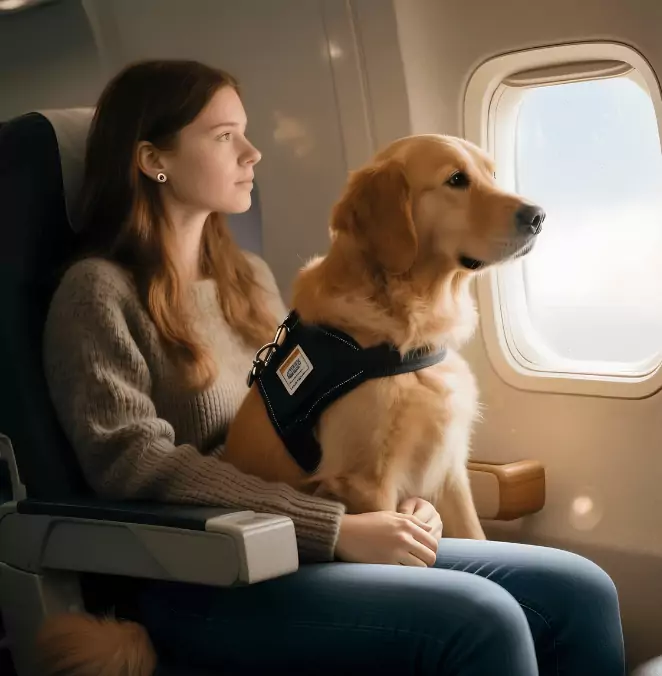
Volaris Airlines Main Takeaways:
-

Psychiatric service dogs fly free on all U.S. flights with the required DOT Service Animal Air Transportation Form.
-
Emotional support animals must travel as pets since January 2021 with applicable pet fees and carrier restrictions.
-
Your dog must perform trained tasks for your mental health disability, not just provide comfort through its presence.
-
Required documents include the DOT form, rabies vaccination at least 30 days prior, and recent deworming treatment.
-
Brachycephalic breeds like Bulldogs and Pugs need a signed liability waiver due to respiratory risks during flights.
-
You must arrive two hours early for domestic flights and three hours early for international flights for smooth check-in.
-
Service dogs must remain harnessed and fit within your foot space without encroaching on other passengers.
Understanding Volaris Airlines’ Service Animal Policy
This guide covers current regulations, required documentation, and what to expect when flying with a psychiatric service dog on Volaris. Federal law now distinguishes between trained psychiatric service dogs and emotional support animals, with only trained service dogs qualifying for free accommodations on U.S. flights.
The Air Carrier Access Act: Federal Law Governing Airline Policies
The Air Carrier Access Act (ACAA), enacted in 1986 and codified at 49 U.S.C. § 41705, prohibits discrimination against air travelers with disabilities. Enforced by the U.S. Department of Transportation through 14 CFR Part 382, the ACAA applies to all U.S. airlines and foreign airlines operating flights to or from the United States. The law requires airlines to allow trained service dogs in the cabin at no charge, provide boarding assistance, and make reasonable accommodations for passengers with disabilities.
Volaris complies with all ACAA requirements on U.S. flights. The airline accepts psychiatric service dogs at no cost, processes required DOT documentation, and ensures passengers with service dogs receive equal treatment.
Important Policy Change: Emotional Support Animals No Longer Recognized on U.S. Flights
Effective January 11, 2021, the U.S. Department of Transportation revised ACAA regulations regarding service animals. This fundamental change affected how airlines handle emotional support animals on all flights to or from the United States.
Before January 2021: Old ESA Rules
- Service animals and emotional support animals both flew free in the cabin
- ESA letters from mental health professionals were accepted as sufficient documentation
- Multiple species including dogs, cats, and miniature horses were accommodated at no charge
- Minimal documentation requirements for ESAs
- Airlines had limited ability to refuse emotional support animals
After January 2021: Current ESA Rules
- Only trained service dogs are recognized as service animals under federal law
- Emotional support animals are no longer considered service animals
- ESAs must travel as regular pets with applicable fees
- PSDs (task-trained) still qualify for free accommodation
- Stricter documentation requirements including DOT Service Animal Form
Psychiatric Service Dogs vs. Emotional Support Animals
The key distinction is task training. Psychiatric service dogs must perform specific trained tasks such as interrupting panic attacks, reminding you to take medication, providing tactile stimulation during dissociative episodes, guiding you to safety during psychiatric episodes, waking you from nightmares, or creating physical barriers in crowded spaces. If your dog only provides comfort without performing trained tasks, it’s classified as an ESA and must travel as a pet with applicable fees and restrictions.
Advanced Notice
Notify Volaris when booking your reservation that you’ll travel with a PSD, then inform staff again at airport check-in. While federal law doesn’t require advance notice, early notification ensures proper seating arrangements and smoother boarding.
Submit your DOT Service Animal Form at least 48 hours before departure if you booked more than 48 hours in advance. If you purchase tickets within 48 hours of departure, complete the form at the airport but arrive at least two hours early for domestic flights and three hours early for international flights.
Contact Volaris by phone from Mexico at +52 (55) 1102 8000, from the USA at +1 855 VOLARIS (865-2747), or via WhatsApp at +52 55 5898 8599. You can also manage reservations and add service dog information online at www.volaris.com.

Volaris Airlines PSD Requirements
DOT Service Animal Form Requirements
The U.S. Department of Transportation Service Animal Air Transportation Form is mandatory for all psychiatric service dogs on U.S. flights. You must attest to your dog’s task training for your psychiatric disability, confirm appropriate public behavior, and verify your dog won’t threaten other passengers.
For flights over eight hours, attest that your dog can refrain from relieving itself or do so sanitarily using absorbent pads. Download the form from Volaris.com or transportation.gov and submit at least 48 hours before departure when possible.
Vaccination Requirements for Psychiatric Service Dogs
- Your psychiatric service dog needs a current rabies vaccination before flying. First-time vaccines must be administered at least 30 days before your flight date to become effective.
- Dogs 15 months or older with previous vaccinations need a current booster dose with no waiting period required. Rabies vaccine validity ranges from one to three years depending on vaccine type.
- Your dog must also complete deworming treatment within six months of travel. Present vaccination records and deworming documentation at check-in.
Health Certificate Requirements
Health certificate requirements vary based on travel direction:
- U.S. to Mexico: No health certificate required, but SENASICA personnel will inspect your dog upon arrival
- Mexico to U.S.: Must comply with CDC requirements including dogs being 6+ months old, valid rabies vaccination, microchip, and freedom from external parasites
- Mexico to Central/South America: Veterinary health certificate required (issued within 5 days on letterhead with license number) plus SAGARPA/SENASICA export certificate
Check cdc.gov and destination country requirements for current regulations as they update periodically.
Brachycephalic Breed Restrictions
Flat-faced breeds including Bulldogs, Pugs, Boston Terriers, Boxers, Shih Tzus, and Mastiffs face higher respiratory risks during air travel. Stress, air pressure changes, and temperature variations can cause respiratory distress, heat stroke, or cardiac complications.
Volaris requires you to sign a liability waiver acknowledging these increased health risks before boarding. Consult your veterinarian about your dog’s fitness to fly, especially for older dogs or those with pre-existing respiratory conditions.
Behavior Standards During Flight
Your psychiatric service dog must remain harnessed, leashed, or tethered at all times in the airport and on the aircraft. The dog must stay under your control within your foot space or on your lap if small enough (no larger than an infant).
Your dog must behave appropriately without excessive barking, biting, jumping, or displaying aggression toward passengers or crew. Dogs cannot occupy seats or tray tables, and cannot block aisles or emergency exits.
Volaris may refuse transport or remove dogs that pose safety threats or cause significant disruptions during flight.
Seating Rules for Psychiatric Service Dog Handlers
You may select any seat except emergency exit rows, which FAA regulations prohibit for service animal handlers due to evacuation safety concerns. When booking, select your preferred seat through Volaris’s website or by calling customer service.
Volaris allows up to two psychiatric service dogs per passenger, provided both fit within your seating area without encroaching on other passengers. For larger dogs, consider requesting bulkhead seats or seats with additional legroom.
No Fees for Psychiatric Service Dogs
Psychiatric service dogs travel completely free under the Air Carrier Access Act. Volaris cannot charge for cabin access, documentation processing, or any disability-related accommodations. You only pay for your own passenger ticket. Airlines are prohibited from charging any fees related to service animal accommodations required by federal law.
Emotional Support Animals: Traveling as Pets on U.S. Flights
Since ESAs are no longer recognized on U.S. flights, your emotional support animal must travel as a regular pet with all applicable fees and restrictions. The only pets allowed on Volaris’ flights are dogs and cats. Pets that are nursing, pregnant, sick, or under four months old are not allowed to fly.
ESA Pet Fees
Pet fees vary by route. Contact Volaris directly at +1 855 VOLARIS (865-2747) or visit www.volaris.com for current pet fees on your specific flight.
Pet Carrier Size Requirements
Only dogs and cats at least four months old are permitted as cabin pets. The carrier must fit completely under the seat in front of you with maximum dimensions of approximately 17.5″ x 12″ x 7.5″.
Your pet and carrier combined must not exceed the airline’s weight limit for cabin pets. The carrier must be well-ventilated, leak-proof, and allow your pet to stand, turn around, and lie down comfortably.
Pet Travel Requirements
Your pet must remain in the carrier throughout the entire flight. Vaccination records are required, and your pet carrier counts toward your carry-on bag allowance. ESAs traveling as pets receive no special accommodations and are subject to all standard pet policies including documentation requirements and potential breed limitations.
US Inbound from High-Risk Countries
Dogs from El Salvador, Guatemala, Colombia, Honduras, or Peru face stricter CDC entry requirements due to rabies risk. As of July 2025, all dogs from these countries need:
- Microchip readable by universal scanner
- CDC Dog Import Form confirmation receipt
- Official rabies vaccination certification
- Minimum age of 6 months
- Clean health inspection upon arrival
This applies to psychiatric service dogs and emotional support animals traveling as pets. Visit cdc.gov/importation/dogs for details. Dogs without proper documentation will be denied US entry.
Important Considerations
- Psychiatric service dogs must perform specific trained tasks for your mental health disability, not just provide emotional comfort, if your dog only provides comfort, it’s an ESA and must travel as a pet
- Always carry printed copies of your DOT Service Animal Form and vaccination records in case of technical issues at the airport
- For connecting flights with other airlines, verify each airline’s service dog policy as requirements may differ from Volaris
- Research destination country import requirements months in advance as many countries require microchips, titer tests, and import permits
- If you experience discrimination or ACAA violations, request a Complaints Resolution Official (CRO) at the airport or file complaints with the U.S. DOT at transportation.gov/airconsumer.

Having a hard time to decide?
licensed professional to see how Wellness Wag can help you qualify for an ESA letter online.
Latest From
Our Library





Are you ready to start the process?
Say goodbye to pet fees and always have your beloved companion by your side, no matter where you live.